Clients and writers sometimes insist that a blog intro be short and brief. Keep it punchy, above the fold. For a while, I just accepted this age-old content-writing wisdom as written in stone. When you start as a writer, in all fields, but especially content writing, you learn to quickly (and often to the detriment of your own writing) listen to whoever is paying you. For content writers, this means bending to the editorial advice of SEOs and marketing managers (i.e., mostly non-writers). Writers have a unique position: they are almost always hired not to bring in new ideas but to follow orders. (Viewed like this, it's no surprise people think AI can replace writers because writers are functioning already, to some extent, as bots that you feed info into to get content out of.)
But the more I write and publish, the more I see content that goes against such age-old wisdom yet still ranks well and converts well. The more I analyze a piece by how it connects to the target reader, ignoring all other honestly arbitrary metrics like content readability, the more I challenge preconceived notions of "good content," such as "keep your intros short."
4 Reasons to Keep Your Blog Intro Short (and Why They Don't Make Sense)
So, why does an intro need to be short? Here are some things I've heard.
Most people don't read intros anyway. They skip over them. If this is true, then why bother making it short? If, let's say, 95% of readers won't read the intro no matter what, then don't cater to them. Wouldn't it make more sense to cater to the 5% of readers who will?
The intro is supposed to tease and pull in the reader. I'm okay with the latter, as "pulling in the reader" is a function of good writing (though this is not limited to the intro). Good content pulls. But pulling in a reader doesn't necessitate that something be short. Sometimes, as we will see below, pulling in the reader requires something long.
But the first part — "to tease" — is silly to me. Why are we teasing? Why are we not providing value from the beginning? A blog intro is sometimes seen as a commercial or trailer for an upcoming movie. But a movie trailer gets you excited about something you haven't yet heard of. A YouTube ad is interrupting something you want, pitching something else. In both situations you're passive, an observer. Content is happening to you.
A blog intro doesn't happen to you. When you click on a blog article, you're already invested. Your reader is active. Now is not the time to tease again — it's time to provide value.
People will get bored and jump off the page. What? People reading content online are looking for that content. They clicked on the link — in the SERP, in an ad, on a landing page. They're actively engaged in finding the content. Plus, if a long intro is enough to get someone to close the page, how will they respond to your body sections? This just doesn't make sense.
SEO favors short intros. Maybe. This kind of stuff is always difficult to verify. The number of factors for any given post makes it really difficult to say whether a shorter intro ranks better than a longer one. But I think we can all agree the last thing search engines want is an army of writers worldwide trimming their intros from 400 words to 200 for the sake of "SEO."
Finally, short and brief are imprecise terms. What does "short" mean? It's a non-quantified amount that will change based on what you're writing. A short intro for a post on making a latte is bound to be shorter than a short intro on a more complex topic. But editors who insist on short intros almost always mean 2–3 short paragraphs, well above the fold — without considering the topic or the audience, just advice they've heard from others.
I think a lot of this stems from people focusing on things that simply do not matter because they're unwilling or unable to focus on the things that do.
Instead of focusing on whether an intro is short or long, focus on whether your intro addresses the specific reader you're trying to reach, provides value, and propels the article forward. More than anything — does your intro keep the reader reading?
Let's look at two examples below, one very short and one very long.
A Very Short Blog Intro Explained
Here's an intro I wrote for Geekbot, for a post targeting the keyword "Range alternatives."

The Geekbot intro — 77 words, including the CTA at the end.
Some things about this intro: it's only 77 words, including the call to action at the end. It's proportionate to the length of the post, which is only ~800 words. The intro takes up roughly 9% of the content.
It's not that short intros are better, and that's why we used one here. It's that this specific keyword and client match-up required a short intro. Geekbot is a relatively straightforward product with simple value props — an asynchronous daily standup integration for Slack and MS Teams. There isn't much to say about the key differences between Range and Geekbot.
When we wrote this article, we assumed the reader didn't want Range but wanted something similar, based on the keyword "Range Alternatives." Because of this, we felt confident simply diving into Geekbot.
As a side note: this entire article is only 800 words, an outlier. Making it that short was not easy. The initial draft was around 1,600 words. I worked with the editor to cut everything we could, trimming it to the bare-bones essentials.
A Very Long Blog Intro Explained
For a different client, I wrote a post about agency reporting software — specifically, 6 ways the client improved their reporting software. The intro, including the CTA, is 689 words. It takes two screenshots to capture; the intro itself goes below the fold.
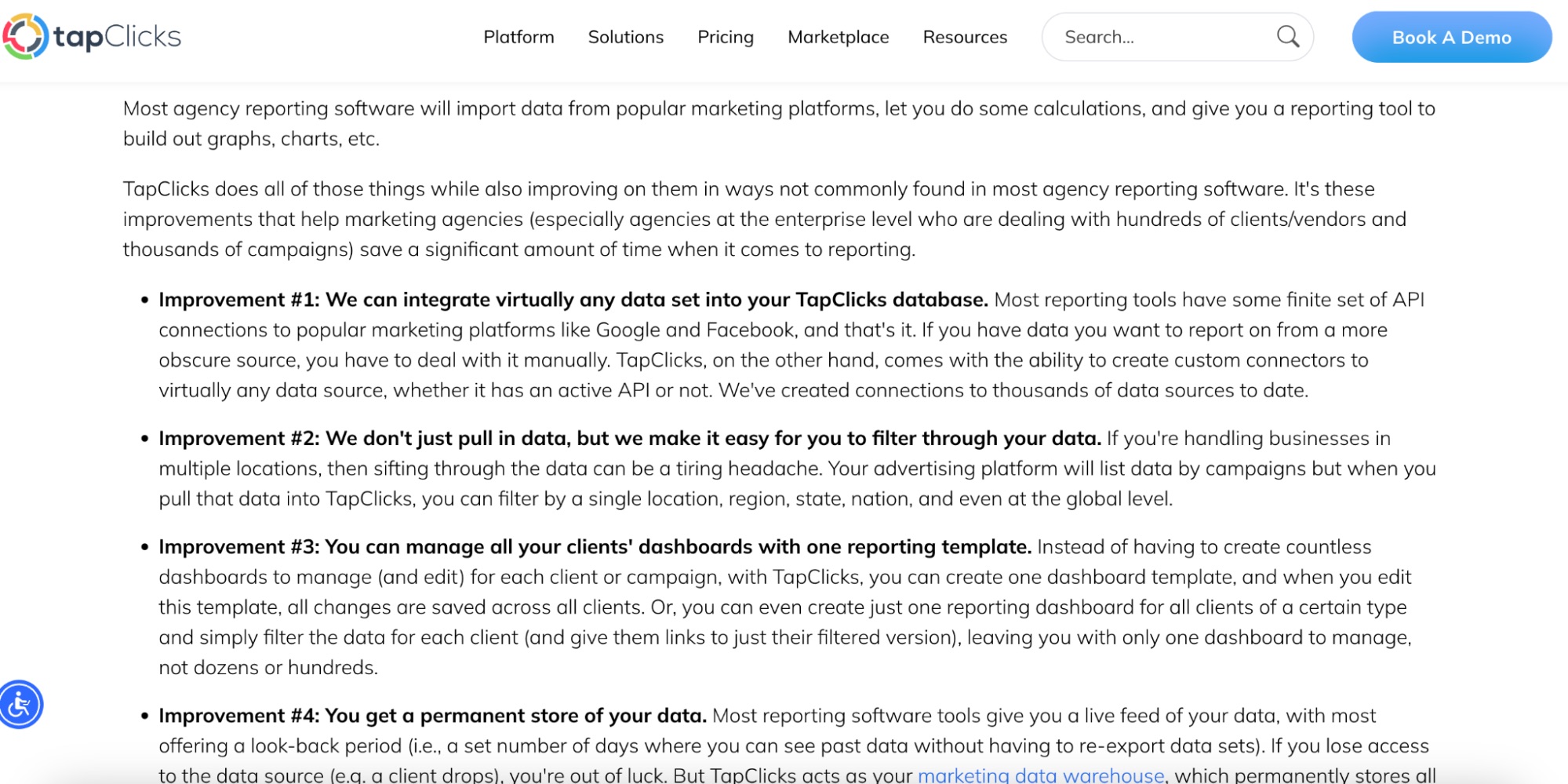
Part one of the intro — already past what most editors would consider "acceptable."
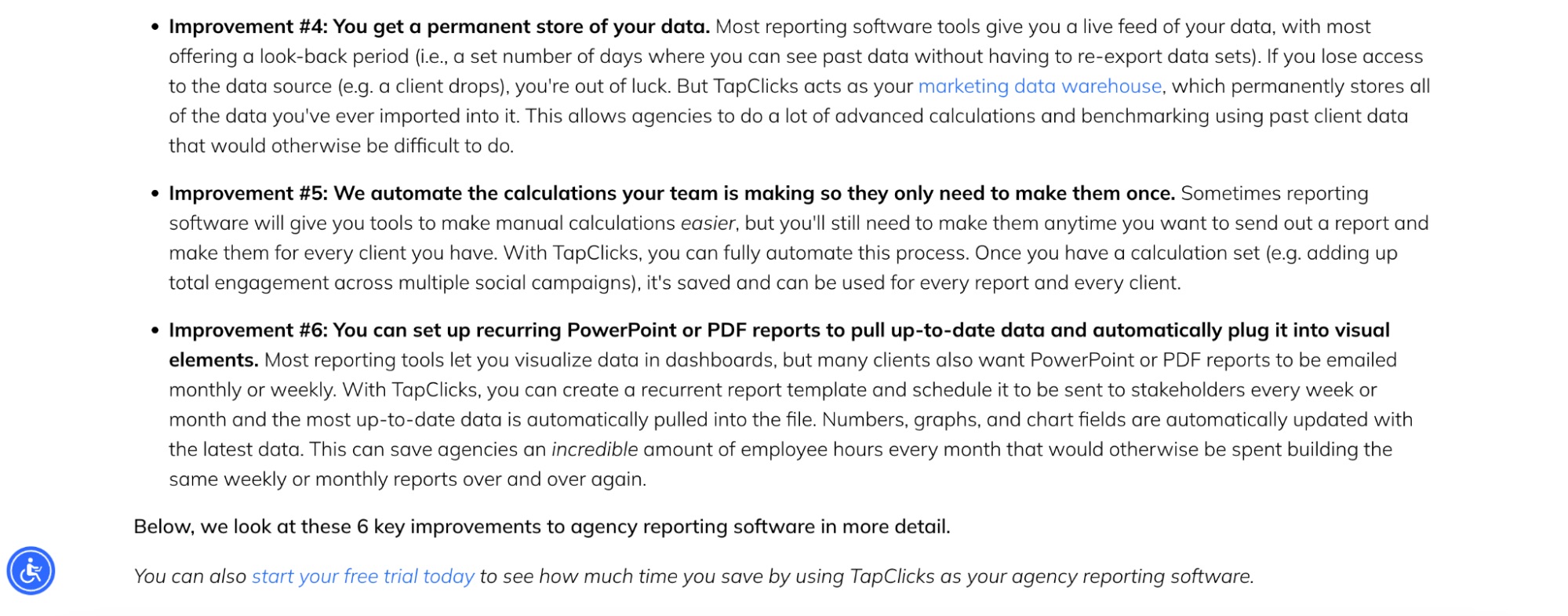
Part two. The full intro is 689 words — not much shorter than the entire Geekbot article.
First, some words on strategy. This keyword is about a much more nuanced software — agency reporting software. Second, the angle of the piece is about how the client has improved and changed that software. It has more meat to it.
Each bullet section in the intro corresponds to a header in the body, and appropriately, each bullet is shorter than its corresponding body section. For example, the first improvement in the intro is 91 words. The body section covering it in detail is 201 words. The second improvement in the intro is 69 words; its body section is 293 words.
My point is that we didn't put everything into the intro — only the specifics meant to convey to the reader that a) we know what we're talking about, and b) we're talking about things they want to know.
The entire article is 5,677 words. The intro is 11% of the piece. Compare that to the Geekbot intro, which was 9%. In short: is this long intro really that long, compared to the article it introduces?
What an editor might actually mean when they say your intro is too long
I'll maintain this: writers and companies do a disservice to a piece of content when they arbitrarily limit the length of an intro. Sometimes a shorter intro works, and sometimes a longer one does.
That said, it's worth meeting an editor where they're at — seeing what their criticism is potentially pointing at, even if it's misguided or worded poorly. Someone's feedback that your intro is "too long" could be pointing to the fact that your intro just isn't very good.
Here are some things to consider when an editor tells you your blog intro is too long.
Maybe it's too fluffy. Your intro can be full of irrelevant information, or include a narrative that, while interesting, isn't critical to the piece.
Maybe you're getting too detailed on one argument. If your post has three arguments and you spend significantly more time on one of them in the intro, it comes across as lopsided.
Maybe you're writing toward too many audiences at once. Trying to reach everyone often means excluding more than you include, and it creates a rambling intro where you're naming every potential reader.
In short: instead of thinking in terms of "too long" or "too short," focus on what the intro is supposed to do, where it's meeting the reader, and where it needs to take them.